
Wading birds
Wading birds
The New Forest is very important for wading birds during their breeding season.
For many years across southern England, the wet and open habitats they need for breeding have been disappearing but in the New Forest, both inland and on the coast, large areas of suitable habitat remain.
Waders nest on the ground and heathland and valley mires with areas of short vegetation and wet ground are essential to their survival.
Because they nest on the ground in the open, breeding waders are very vulnerable to predators such as crows, badgers and foxes that eat the eggs or chicks.
Nests can also fail if the adults are scared off the eggs too frequently – the eggs then get too cold, or the adult birds may simply give up trying to breed in the first instance.
On heaths and wet ground, walkers should therefore keep themselves and their dog to the main tracks when waders are nesting (usually March – July).
Keep your dog close to you and visible at all times – if necessary use a lead.
Guides to wading birds
Ground Nesting Birds
Download Guide Download GuideHeathland Highlights
Download Guide Download GuideCurlew
As a breeding bird the curlew is uncommon in southern England; it is much more common (but declining) in the north and west of the UK.
The New Forest is now one of the only areas of south east England where the curlew still breeds. Here they are widespread but uncommon, with less than 40 pairs.
Curlews require quite a large open area in which to breed. The wide expanses of short-grazed open heath, grass and bogs of the New Forest suit them well. A few pairs also breed in the adjacent Avon Valley and less intensive farmlands around the edge of the Forest.
They usually start nesting in late April and May and incubation takes about one month. The young tend to stay relatively close to the nest until they grow their proper flight feathers and can fly. This happens about five weeks after hatching and means that curlews need to be relatively undisturbed from mid-April to early July to ensure they breed successfully. They are particularly wary birds and so will only breed in the larger expanses of open ground away from where people walk.
Curlews are so named because of their far carrying call of ‘cur-lee, cur-lee’. They also have a wonderful bubbly-sounding display song.
Curlews head for coasts after they have finished breeding. They like large areas of mudflats and saltmarsh, so it is actually much easier to find them there in autumn and winter than it is to find them inland in the summer.
The best way to help curlews is to let them breed successfully. In any open areas please stay on the main footpaths and keep dogs close to you; otherwise you are more likely to scare the birds off than to see one.
ID tip – The curlew is a large brown wader with a long down-curved beak. The only other brown wader with a down-curved beak is the whimbrel which passes through on migration, has a different call and has prominent black and white stripes over the crown of the head.
Lapwing
Breeding lapwings are widespread throughout the UK except Cornwall and Devon.
Traditionally a bird of mixed farmland, they still breed throughout Hampshire but in much smaller numbers than in the past. In the New Forest they breed both in the central open heaths and grassland (around 150 pairs) and in the surrounding farmland.
Lapwings like to nest on very open, almost bare ground that is close to grassland where they can take their chicks once they hatch. They need a patchwork of bare areas, grass and some damp ground or wetland edges where the chicks can find food.
Lapwings are very wary birds and will noisily complain at any potential predator anywhere near the nest. They will fly up and dive-bomb crows, foxes, dogs and even people, to drive them away from the nesting area. While they are doing this they leave the nest and hope that the camouflaged eggs or chicks are not found.
Lapwings have a swooping display flight that they perform over their breeding grounds together with weird electronic calls, almost like toys!
If you want to see lapwings, especially their displays, then the most reliable areas are the short grazed grasslands at the coast near Lymington and the best time of year is March to May.
Lapwings flock together in winter and are easily seen on arable fields and along the coast at that time of year.
ID tip – The lapwing is an unmistakable wader with a dark glossy green back, white underneath, black crest on the head and short beak. In flight they appear black and white with rounded ends to their wings.
Little ringed plover
Little ringed plovers are unusual among waders that breed in the New Forest as they are a summer visitor. They arrive in March, breed and then leave in August.
They only colonised Britain in the 1940s and have bred annually in Hampshire since 1971. Although fairly widespread across central and southern England they are still uncommon, and they are rare or absent from Wales, Scotland, northern England or south west England.
Little ringed plovers breed on bare stony ground in open areas by freshwater. Occasionally, shingle river islands are used, but they are mostly seen around gravel pits and reservoirs.
Around the New Forest they only regularly breed at the complex of lakes at Blashford just north of Ringwood – try looking from the Tern Hide from mid-March to May. You may also see them displaying on the shingle islands and banks of the coastal lagoons between Keyhaven and Lymington.
ID tip – Little ringed plovers are brown above and white below with black and white stripes on the head and a short beak. They are very similar to ringed plovers but have a yellow ring around the eye, flesh-brown legs, black bill and no white bar on the wing when they fly.
Oystercatcher
The oystercatcher is a widespread breeding bird in northern England and Scotland, but in southern England and Wales they are almost restricted to the coast. In Hampshire they breed on the coast, plus one or two pairs sometimes breed on the Forest or in the Avon Valley.
Oystercatchers nest in very short grassland or, more often, on bare ground such as shingle beaches. The nests are always close to water where the adults can take the chicks on hatching. They can be quite noisy in their attempts to drive away predators from their nesting areas.
The best place to see oystercatchers is along the coast between Keyhaven and Lymington or around Needs Ore. Here you’ll find them at any time of year but especially in winter when migrants from further north and west join the relatively small population of resident birds.
ID tip – The oystercatcher is our only wading bird that is black and white with a long, bright orange beak.
Redshank
Redshanks are now widespread in inland UK with the greatest concentrations in north England and lowland Scotland.
The Hampshire-wide population has contracted to become largely coastal – the Solent is an important area for them in southern England.
Redshanks nest in wet grassland that is mostly short with scattered longer tussocks. They place their nest in a tussock so that they are hidden, but can easily see out and keep a watch for predators. Grazing is important to keep the majority of the grass fairly short.
Redshanks are noisy birds at their breeding sites and persistently call if any would be predators are near. This species nests in only very small numbers (say 10 pairs or fewer) within the central New Forest wetlands. In recent years none have been successful away from the coast and the Avon Valley.
In the New Forest, one of the best areas to find redshanks is the coast between Keyhaven and Lymington. Here you can walk the raised coastal path and see them feeding on the mudflats or around the pools at any time of year and any time of day.
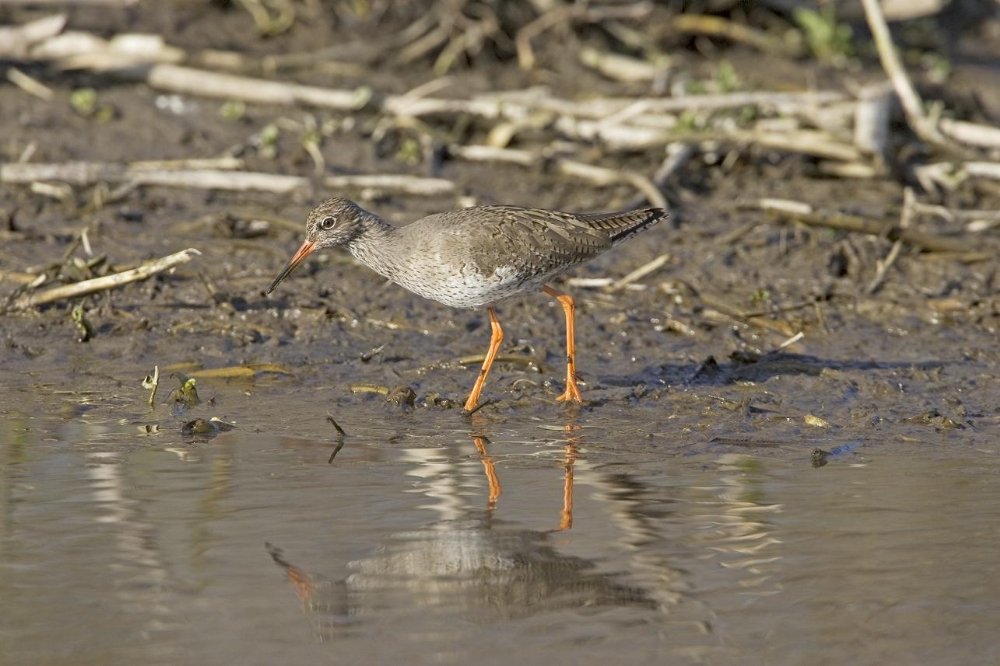
ID tip – Redshanks are mostly mottled brown, with red legs, red at the base of the beak and a conspicuous white trailing edge to the wings in flight.
Ringed plover
Ringed plovers breed all around Britain’s coastline, including Hampshire, and they also occur inland in many areas.
They nest on bare ground, such as shingle and sandy beaches, and rely on their camouflage when sitting on the nest. The eggs and chicks are very well camouflaged too. Ringed plovers are vulnerable to disturbance and successful breeding will only occur along the less disturbed beaches or areas without public access.
If breeding ringed plovers are disturbed near the nest they can entice the predator away in a novel way – they pretend to be injured. The adult will flap along the ground as if it has a broken wing and run away from the nest. A predator such as a fox (or an inquisitive human) will follow the adult away from the nest. Once far enough away, the adult flies off and will only return to the nest when danger has past.
In the New Forest, the best place to see ringed plovers is along the coast. The area between Keyhaven and Lymington is particularly good – they breed around the pools or on small islands within the pools that lie just inland of the sea wall walkway.
Snipe
As a breeding bird the snipe is now uncommon in southern England, but it is much more common in the north and west of the UK.
In the New Forest snipe are fairly widespread but still rare, with perhaps 100 pairs in total – they are decreasing dramatically in southern England so the New Forest population is an important stronghold.
Snipe require wet areas with plenty of rushes interspersed with short grass. To breed successfully they need the ground to remain wet over the spring and summer so that they can probe in soft soil and find food close to their nest. The New Forest bogs and mires provide such a habitat and are good for snipe. The grazing ponies and cattle help to keep the wetland areas roughed up and this provides plenty of small wet hollows and hoof prints in which snipe can find their food.
Snipe are probably less vulnerable to disturbance than other breeding waders because they sit tight, relying on their camouflaged plumage rather than flying away from would be predators. Also people and dogs tend not to walk through their wetland habitat.
Snipe have a wonderful display flight called drumming. They circle their territory in spring, usually early and late in the day and repeatedly fly up and then dive. As they descend the air passes between their tail feathers and creates a strange vibrating sound. They will also make rhythmical ‘chippa-chippa’ calls from within their marshy territories, perhaps even perched on a fence post in full view.
Any of the wetland areas in the New Forest area may hold breeding snipe. One fairly good area is along the old railway line near Holmsley. Try early mornings in April or May.
Alternatively, you can see them in winter along the coast or along river valleys. They usually feed around the edges of marshy lagoons, and roost tucked away amongst grassy tussocks – scan the margins of pools between Keyhaven and Lymington to find them.
The best way to help snipe is to let them breed in peace; please keep your dog out of wetland areas and bogs, especially in spring and summer.
ID tip – The snipe is a fairly small brown wader with a conspicuously long straight beak and straw coloured stripes along the head and down the back. Another species, the woodcock, has a similar shape but is larger and has bars across the head and a mottled brown back. In flight, especially when flushed, snipe tend to zig-zag erratically.
Woodcock
Woodcocks breed throughout England, Wales and Scotland, but they are more common in the north. The heathy woodlands of the Hampshire, Dorset and Surrey are strongholds for them in southern England and the New Forest population is particularly important. Unlike many other waders they do not feed on coastal mudflats and salt marshes, even in winter.
Woodcocks breed in damp woodlands especially where there are gaps between and under the trees. The mosaic of habitats across much of the New Forest, including the acid heathlands, is ideal for them. Woodlands on chalk downland tend to be too dry, and coppiced woodlands on the clays are often too dense with a lot of shrubs.
Conifer plantations can also be a good habitat for woodcocks, usually before the trees grow up too tall and especially if there is a variety of age blocks within the same area.
Woodcocks perform a distinctive display flight called roding: they fly over and around the edges of woodlands at dusk and dawn, making strange squeaks and grunts. During the day they rest or feed quietly in woods and are not often seen. At night they venture into open areas to feed.
Woodcocks are quite widespread across the New Forest and can be seen around any of the woods with adjacent heathland. A very reliable area is the woodland just east of Blackwater car park. It is best to go at dusk on a late spring or early summer evening. Try May or June.
ID tip – The woodcock is a medium-sized brown wader with a conspicuously long, straight beak, bars across the head and a mottled brown back. The snipe has a similar shape and overall colour but has straw coloured stripes down the head and back and an erratic zig-zag flight.