
Hampshire Ornithological Society seeks suitable homes for threatened summer visitors ahead of the 2027 breeding season
Residents, schools and local businesses in the New Forest are being invited to apply for free artificial nests as part of a major Hampshire-wide effort to help threatened house martins.
Following a successful pilot last year, Hampshire Ornithological Society plans to install up to 900 artificial nest ‘cups’ across the county before the birds return from Africa in April and May 2027 and is calling on local nature lovers to put their names forward.
Properties must be within 1km of a previously recorded house martin nest. In the New Forest they have been spotted in areas such as Lymington, Brockenhurst, Beaulieu, Burley, Fritham, Cadnam and Bransgore with colonies concentrated along the Lymington, Beaulieu and Avon rivers, where mud and insects are plentiful. One of the largest colonies in Hampshire was at Exbury Water Tower, where 78 active nests were counted in July.
Host buildings must have suitable overhanging eaves at second story level, between four and seven metres from the ground. Residents can check whether their property may be suitable and request free nests at www.hampshirehousemartins.org.uk.
Between 1995 and 2024, the UK House Martin population fell by 40%, partly due to poor breeding success. The birds build distinctive cup-shaped nests beneath the roofs of houses and other buildings, carrying around 1,000 pellets of soft mud to complete each one. Even in good conditions, this can take over a week but during prolonged dry weather, as seen in Hampshire this summer, supplies of mud literally dry up.
Predators, including sparrowhawks and magpies take their toll and nests often fall to the ground from modern plastic eaves which are more slippery than wood, leaving eggs and young on the ground to die. Declining insect numbers may also be making it harder for the birds to find enough food. The species is now on the UK’s Red List of birds of greatest conservation concern.
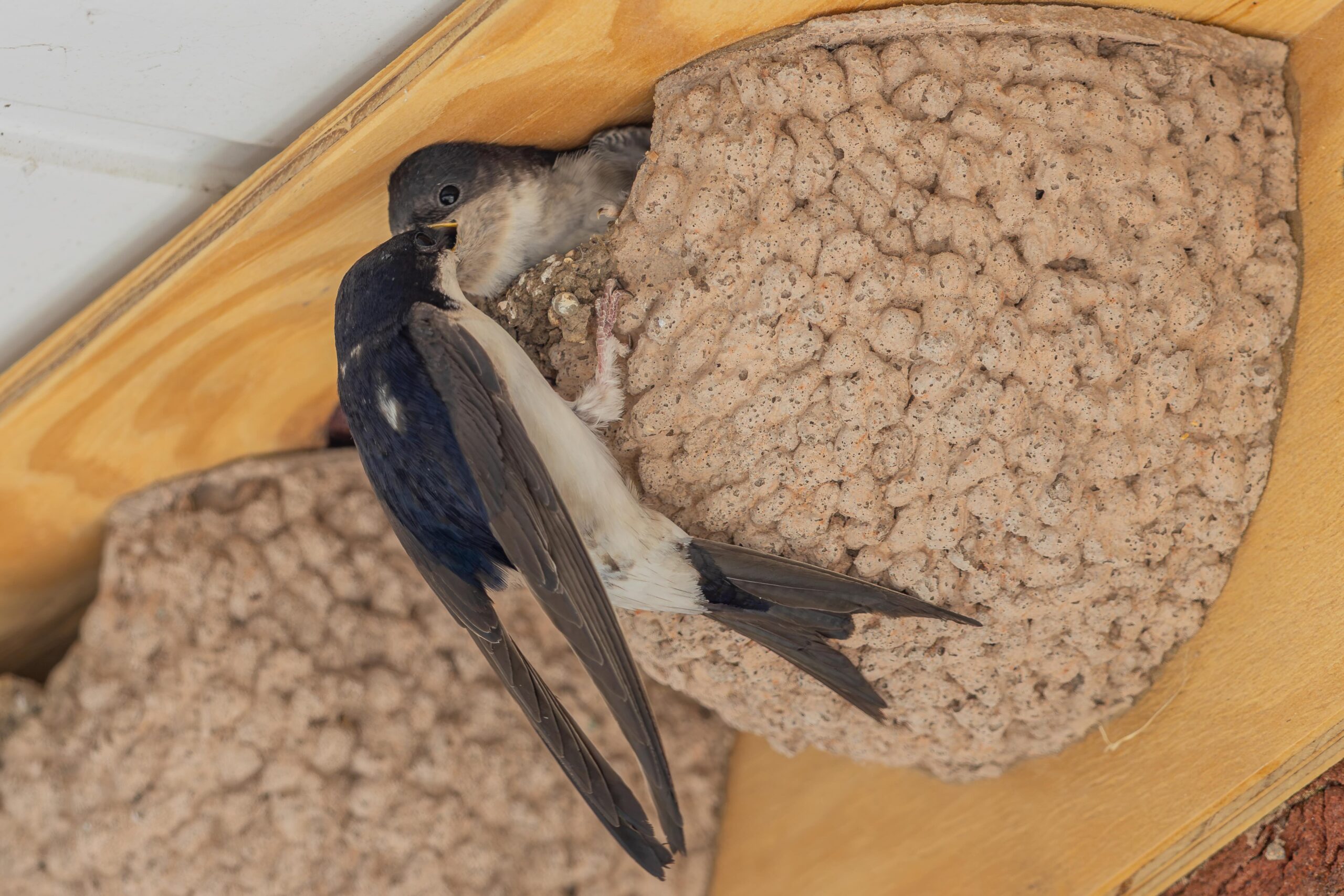
The artificial nest cups look like natural nests but are made from woodcrete which is much stronger and more durable than mud.
Nigel Matthews, volunteer coordinator for the Hampshire House Martin Project, said: ‘Our pilot showed that house martins will readily use artificial nest cups when they are installed in suitable locations close to existing colonies.
‘We are now looking for householders and other property owners in the New Forest who would be willing to give these remarkable birds a safe place to raise their young. The artificial nests will be provided and fitted free of charge so demand is likely to be high. Anyone interested should visit our website, check the eligibility criteria and complete the online application form.’
During the project’s pilot, 249 artificial nest cups were installed across northern and eastern Hampshire; 27 were used by house martins this summer, more than the project team had expected. The cups were placed on buildings close to known nesting sites because house martins breed in loose colonies with several nests on nearby properties. They team up to look for suitable supplies of mud, and insects to feed on, and warn each other of approaching danger.
Thanks to citizen science, several hundred existing house martin nests sites have already been mapped across Hampshire. This round of free nest cups will take the total to more than 1,000 nest cups fitted over two years, helping existing colonies to grow while gathering evidence about why house martins choose some locations but not others.
View the map and report a house martin nest by visiting: www.hampshirehousemartins.org.uk/tell-us-where-they-are-nesting. Nests should be observed from a safe distance and nesting birds should not be disturbed.
The Hampshire-wide scheme is led by Hampshire Ornithological Society and supported with funding by Birds on the Brink, House Martin Conservation UK & Ireland, the New Forest Biodiversity Forum, the New Forest National Park Authority’s Sustainable Communities Fund, Portsmouth Water, the South Downs National Park Trust’s Sustainable Communities Fund, South East Water, Stannah Lift Group and Thames Water.
Keith Betton, chair of Hampshire Ornithological Society, said: ‘The response to the first pilot stage of this project showed how strongly people across Hampshire want to help House Martins. This next phase turns what we have learnt into action by offering hundreds more safe, ready-made nests. It gives homeowners, schools and businesses a simple, practical way to support the recovery of this threatened bird.’
House martins are easy to identify: they are blue-black above with a bold white rump, and white beneath. The forked tail is much shorter than on a swallow which tends to nest inside barns and porches, not beneath the roof on the outside.
-ends-
For further information contact Emma Mason emma@emmamasonpr.co.uk 07762 117433 or Nigel Matthews nigel@hampshirehousemartins.org.uk 07754 765656
Notes to editors
The Hampshire House Martin Project is led by Hampshire Ornithological Society to raise awareness of House Martin declines, increase knowledge of nesting sites and population size, and provide artificial nest cups to improve breeding success.
Photo captions
House martins using a nest cup ©Steve Laycock.