
Deer
Deer
The New Forest National Park is a special place for nature with many rare and important habitats and species. Deer have long been part of our history and cultural heritage. Indeed William the Conqueror set up his ‘Nova Foresta’ or ‘New Forest’ in 1079 as his Royal hunting ground, and the deer have continued to shape the landscape we know today.
Deer populations have increased dramatically across England in recent decades, with their numbers growing to such an extent that they are having a detrimental impact on habitats, such as those found in and around the New Forest. The New Forest National Park Authority is working with Natural England and the Forestry Commission on a new project that will provide a long term, landscape-scale approach to deer management across the New Forest National Park and surrounding area, providing hope for habitat restoration. You can read more about the project here.
Five out of six species of deer found in the wild in the UK live in the New Forest. The four most common species are fallow, roe, sika and red deer, with muntjac deer also increasingly present across the landscape.
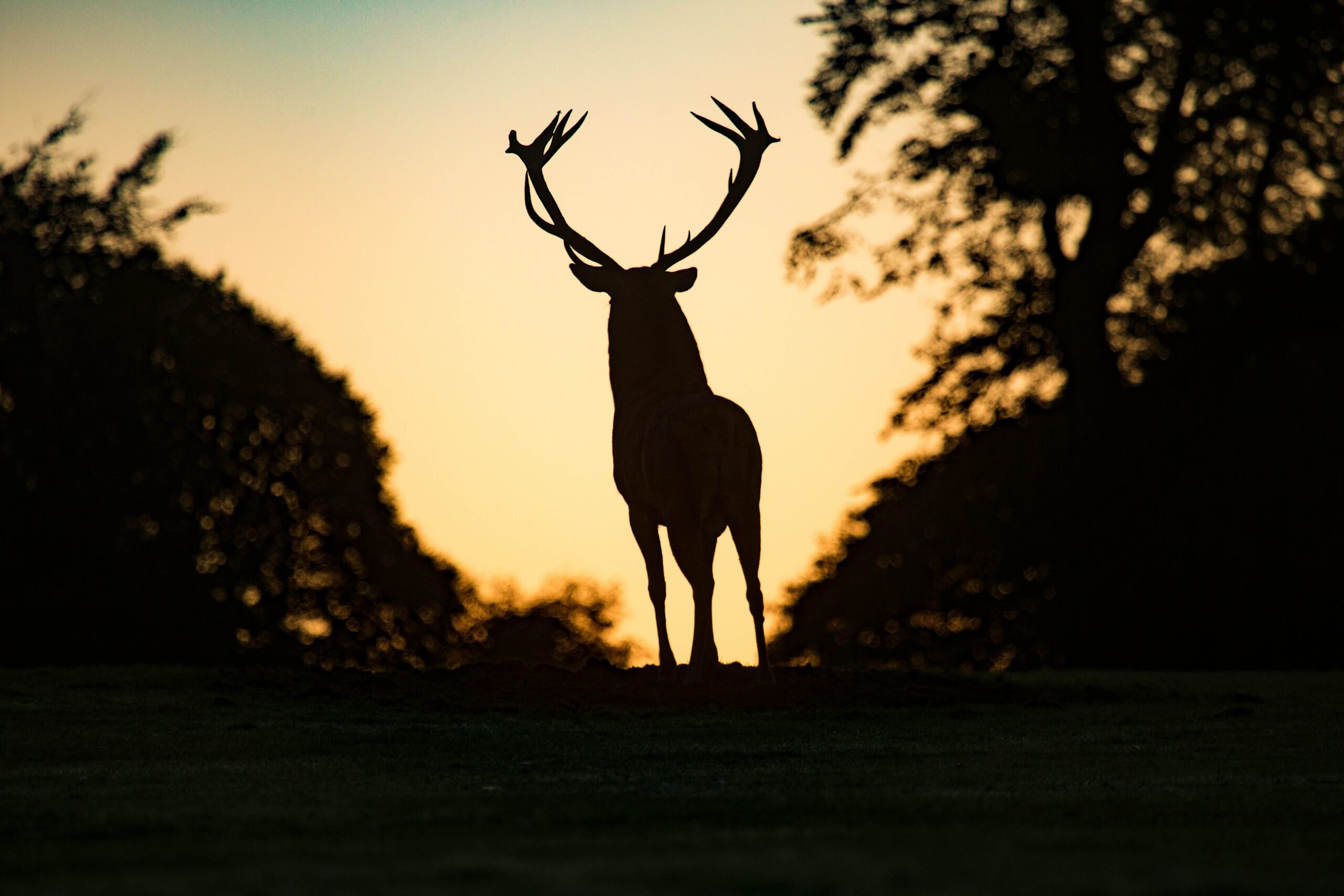
Each year, deer take part in the rut (the mating season). The rutting month varies between species, but mostly it is during the autumn. Stags use their antlers in fearsome trials of strength and an enraged or injured stag can be a dangerous animal so please keep your distance.
Although you may not often see the deer themselves, you can frequently see the signs they leave. Look out for their footprints, called slots, and their droppings, looking like large raisins.
Fallow Deer
Fallow deer are the most commonly seen deer in the New Forest National Park. Although not a native species, they have been present since Norman times and have the longest continuous lineage of any deer species in the Forest. They are common throughout England and Wales, but less so in Scotland. Mature males, which have palmate (webbed) antlers, are known as bucks, the females as does and their young as fawns.
Fallow deer gather in herds and they feed in mature deciduous woodland, particularly at the time of the autumn mast crop and in winter when their diet includes a greater proportion of woody browse. They can also be seen grazing on open land such as woodland clearings, grassy rides and open forest habitats. They can be seen almost anywhere in the Forest, but deciduous woodland is the best place.
The New Forest was William the Conqueror’s first hunting forest in England, and the hunting of fallow bucks took place for over 900 years until it was outlawed in 1997.
Fallow deer are smaller than red deer and are mainly chestnut brown in summer, more grey in winter, and usually with an abundance of white spots, although the colour ranges from black through various browns to white. Their most characteristic feature is the black and white backside, which differs from sika in having a black stripe down the tail, through the white area.
Muntjac Deer
Muntjac are not frequently seen in the New Forest, partly due to numbers but also because of their smaller size compared to other deer species.
They were introduced from China to the Duke of Bedford’s Woburn Park in the late 19th century. They escaped, or were deliberately released, and soon established wild populations. Now they are widespread in southern and central England, getting scarcer as you go north, but they continue to spread and increase in number.
Muntjac like cover and live predominantly in woods with plenty of scrub in the understory. In urban areas they are often seen in gardens.
Muntjac are also known as barking deer due to their repeated loud barking, and they also scream or squeak when alarmed. Unlike other species of deer in the UK, muntjac do not have a defined breeding season and can breed all year round, with the females able to conceive again within days of giving birth.
Muntjac are small, dog-sized creatures with long back legs. This gives them a raised and rounded back end, making them look almost pig-like. The males (bucks) have short, simple antlers. They are generally solitary or found in pairs (doe with kid or buck with doe).
Red deer
The red deer is Britain’s largest land mammal and it is a true native species. As well as the New Forest, they are also found in East Anglia, Exmoor, north-west England and Scotland.
Red deer can be seen in various parts of the New Forest. They are herding animals and spend most of the year in the woodland areas, although they may sometimes come onto the open heath. Red deer have the potential to inter-breed with sika, so management aims to keep the populations apart.
Please make sure that you stay on the main track at all times and keep dogs under close control while in the deer conservation area. Always keep your distance – binoculars are essential! Do not approach the deer – they are wild animals.
The red deer is a rich red-brown animal about the same size as a cow with a pale brown patch on the backside. Many males, known as stags, have more than 10 points (also called tines) on their antlers, while a ‘Royal’ has 12 points. The female is a hind and the young are called calves, while a male in its second year with its first antlers is a brocket.
Roe deer
The roe deer is a true native species found in the New Forest, and are widespread and common throughout the UK.
Roe deer are essentially woodland animals. They can be seen in any of the more wooded areas of the New Forest at any time of year, but less so in high summer. They often venture into fields, browsing scrub and grass and can cause damage to cereal crops outside the Crown lands.
When alarmed, bucks and does (males and females) give a short bark, often repeated. The roe deer rut is in July, much earlier than other species of deer. However the young (called kids) are born at the same time of year as other deer species, due to delayed implantation, a process in which the fertilised embryo does not attach to the womb until a few months later. Roe deer are the only hoofed animal to do this.
Roe deer are small, being around 65cm (26 inches) high at the shoulder – about the size of a small sheep or goat. They are mid-brown in summer and greyer in winter, with a characteristic white backside that is easily seen as they run away from you. They have short, three-pointed antlers.
Sika deer
This close relative of the red deer originates from eastern Asia and has been introduced to the UK. In the New Forest, sika were introduced into the Beaulieu Estate in 1900, and the New Forest population is one of the UK’s purest. Sika are increasing in the UK, and the New Forest / Dorset area is one of its main strongholds.
Sika favour a mix of heathland and coniferous woodland. In the New Forest the population is kept to the south-east, between Brockenhurst and Beaulieu. There is a risk of cross-breeding (hybridisation) with the native red deer, so efforts are made to keep populations apart where possible.
Sika are sensitive to human disturbance and hide in woodland by day, venturing out onto open heath or farmland at night. They tend to be solitary for most of the year and only form small groups in winter.
Sika are a similar size to fallow deer and are best distinguished by their backside, which is white with black at the top. Fallow deer have a black stripe (the tail) running down through the white. Sika have branched antlers similar to red deer but with a maximum of eight points.